Coding Was Never The Bottleneck - Really???
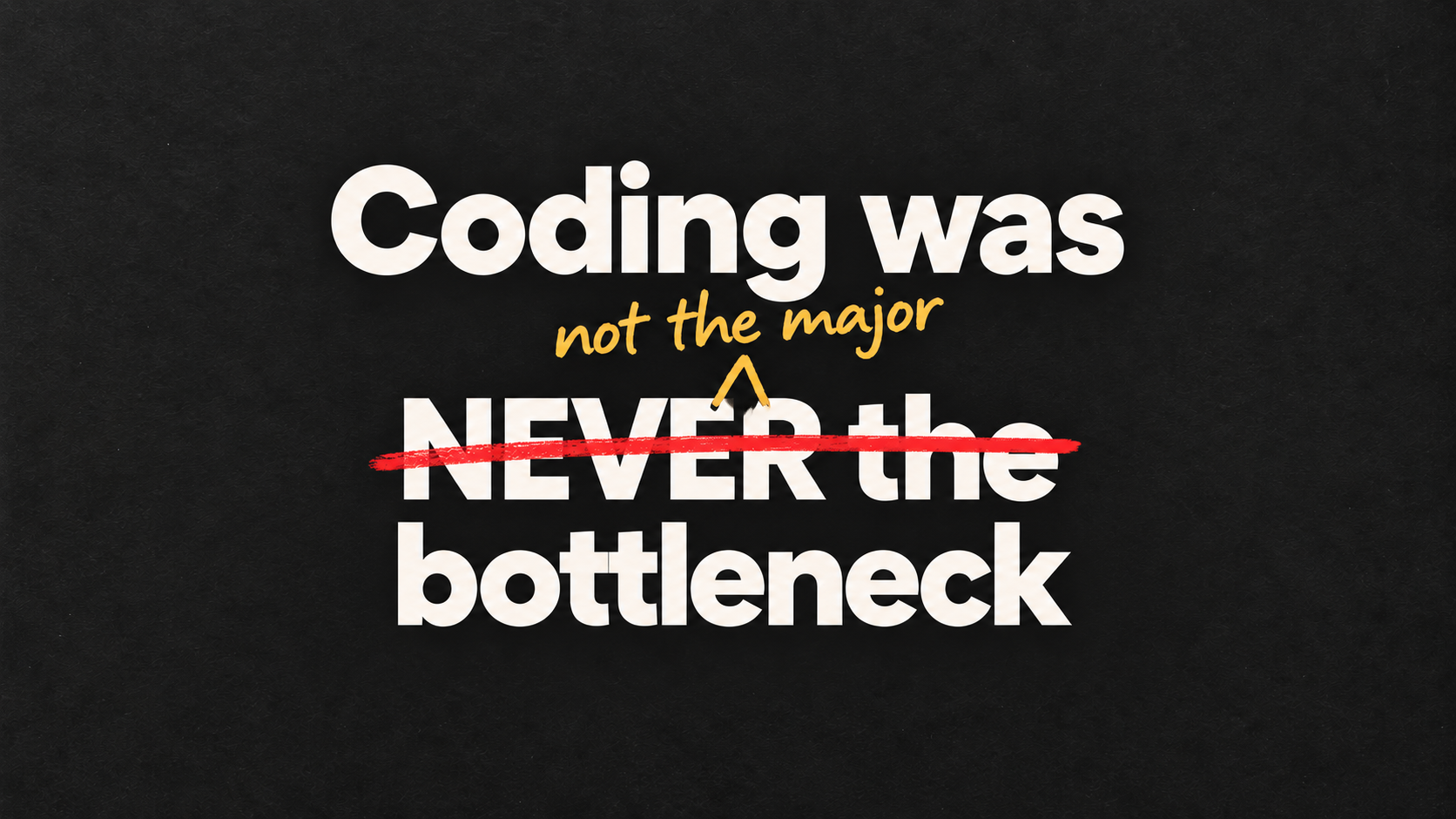
There is a phrase making the rounds in the age of AI coding agents:
“Coding was never the bottleneck.”
It sounds profound.
And it contains a grain of truth.
In many software projects, writing code is not the biggest obstacle. You can spend weeks figuring out what to build, why to build it, who the users are, what the requirements actually mean, how the business model works, and how the system should fit into the existing ecosystem.
Compared to all that, typing code into an IDE can look like the easy part.
But there is a problem with taking the statement too literally.
Coding may not be THE bottleneck. But coding absolutely can be A bottleneck.
And dismissing that fact grossly undermines the importance of software craftsmanship.
Coding Is More Than Typing Code
Perhaps the biggest problem is how we define coding.
If coding means taking a well-defined requirement and typing the implementation into an IDE, then yes, coding is becoming incredibly cheap.
Give an AI coding agent a sufficiently detailed specification and it can generate hundreds or thousands of lines of code in seconds.
But professional software development has never been merely about typing.
Coding involves learning the technology stack, understanding the framework and runtime, exploring implementation approaches, making trade-offs, writing working code, debugging it, testing it, refactoring it and making it maintainable.
It means understanding why the code works, why it doesn’t, and what will happen when the requirements change.
All of that is coding.
Software craftsmanship doesn’t disappear because the keyboard is no longer doing most of the typing.
The Last Mile Still Matters
Suppose we’ve done everything else right.
We’ve identified a real problem, validated the market, understood the users, analyzed the requirements, designed the experience and arrived at a sound architecture.
We still don’t have software.
A requirement isn’t a product. A design isn’t a running system. An architecture diagram isn’t production infrastructure.
Eventually, all that thinking has to become something concrete.
And the quality of that implementation matters.
Poor implementation can make a system slow, unreliable, insecure, difficult to operate and prohibitively expensive to change.
So perhaps coding isn’t the biggest hurdle in getting a software product out the door. There may be many bigger ones.
That doesn’t make coding unimportant. It makes it one of the critical stages where intent becomes reality.
The Irony of “Coding Was Never the Bottleneck”
There’s an even bigger problem with saying:
“Coding was never the bottleneck. AI just proved it.”
AI didn’t prove that coding was never the bottleneck.
It proved that typing code was not always the bottleneck.
That’s a very different claim.
We’ve been progressively making code production cheaper for decades.
Compilers abstracted away machine code. Higher-level languages increased developer productivity. Libraries eliminated repetitive implementation. Frameworks standardized common patterns. IDEs made development faster. Search engines and Stack Overflow made knowledge easier to access.
AI is the next massive step in that progression.
It removes even more mechanical work.
But none of those advances made software engineering irrelevant. They expanded what developers could accomplish.
AI is doing the same thing.
Coding Skills Are Still Leverage
This doesn’t mean developers need to manually write every line of code.
Quite the opposite.
A skilled developer working with AI may be dramatically more productive than the same developer working without it.
But the important word is skilled.
AI increases the leverage of engineering ability.
It doesn’t automatically eliminate the need for it.
The more code machines can produce, the more important it becomes to have people who can determine whether that code should exist, whether it is correct, whether it is maintainable, and whether it solves the actual problem.
That’s software craftsmanship.
The Executive Trap
The phrase “coding was never the bottleneck” can become more than just an inaccurate technical statement.
It can become a dangerous management assumption.
Imagine a senior executive hearing:
“AI can now build software in minutes. Coding was never the bottleneck anyway.”
The obvious next question is:
“Then why do we need so many developers?”
And suddenly a nuanced observation about software development gets transformed into a simplistic productivity calculation.
If generating code is now dramatically faster, it can be tempting to assume that software teams should become dramatically smaller, projects should become dramatically faster, or engineering costs should fall proportionally.
But software doesn’t work that way.
The time required to type code was never the entire engineering effort.
Someone still needs to understand the business problem, turn ambiguous requirements into precise behavior, make architectural decisions, evaluate trade-offs, validate the implementation, test edge cases, integrate with existing systems, deal with security and operational concerns, debug failures and maintain the system after it goes live.
So, Is Coding the Bottleneck?
Sometimes.
Sometimes it isn’t.
There is no universal bottleneck in software development.
For one product, the problem may be product discovery. For another, distribution. For another, regulatory compliance, data, infrastructure, security, organizational alignment or funding.
And for some systems, implementation complexity itself is a major constraint.
So the useful distinction isn’t:
Coding vs. everything else.
It’s:
Coding is not necessarily THE bottleneck.
But:
Lack of coding and engineering skills can absolutely be A bottleneck.